

Luck… and the pot of gold problem.
March 17, 2026
User Portal 3.1 Release Notes
March 31, 2026
When the Machine Said the Quiet Part Out Loud
This all started innocently enough.
I was doing research on bus companies using AI tools.
Not an audit.
Not a sting operation.
Not some elaborate effort to prove a point I had already decided to make.
I wasn’t trying to justify a presentation. I wasn’t trying to refine the prompts I’ve been sharing with the industry. I wasn’t hunting for a villain in a black hat twirling his mustache behind a Google result.
I was just doing what many of us do now: asking an AI agent to help sort through information.
And then, in the middle of that ordinary research, it said something that made me stop.
It said… The AI overview is dominated by brokers (GOGO Charters, CharterUP). Let me scroll past to see organic results where operators rank.
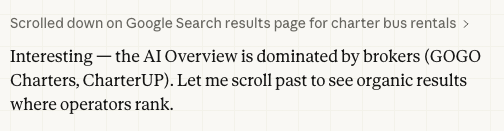
There it was.
A passing observation as it tried to find the data I was asking it for. A machine, not trying to make a speech, simply describing what it saw.
And in one sentence, it confirmed what I have been teaching in classes, showing in screenshots, and talking about with operators for months:
The ground is shifting under search, and brokers are already standing on the high side of the hill.
That matters.
It matters a lot.
Because this is not really about search rankings anymore, at least not in the old familiar way. This is about something much bigger: WHO IS STANDING WHERE THE CUSTOMERS ARE LOOKING.
That is the fight. The only fight that matters in terms of landing more business. Because IF we are not being seen no amount of marketing, sales, pricing strategy, fuel surcharges, or much of anything else will help.
SEO Is Not Dead. But its on life support.
For years, the playbook was relatively straightforward.
You worked on your website.
You improved your pages.
You built relevance.
You chased rankings.
You hoped the customer clicked.
It wasn’t easy, but it was understandable. It was like fishing in a lake where everyone at least agreed there was still water in the lake.
Now? The lake has a shopping mall built over it.
Search behavior is changing in plain sight. Google has said there has been a “profound shift” in how people use Search since the launch of AI Overviews, with users asking more complex and longer questions. Google also expanded AI Overviews to more than 200 countries and territories and says they now reach more than 1.5 billion users each month.
That should get everyone’s attention.
Because when search becomes a summarized answer instead of a list of links, visibility changes from a sliding scale to something much more brutal:
You are either included in the answer or you are not.
That’s the new binary.
And if you are not, then to a growing number of buyers, you are effectively invisible.
Not bad.
Not second-best.
Not on page two.
Invisible.
That is a tough word, but it is the right one.
The Click Is No Longer Guaranteed
One of the great comforts of old-school search was this: even if you weren’t first, there was still a chance. A customer might compare. They might browse. They might click three or four results and eventually find the operator with the better service, the better equipment, the better safety culture, or simply the better people.
That cushion is getting thinner.
A 2024 SparkToro/Datos analysis found that 58.5% of U.S. Google searches ended without a click to the open web, and in the EU the number was 59.7%.
Think about that for a moment.
More than half the time, the search ends before the website visit even begins.
So when someone tells me, “Well, our website is good,” I believe them. I’m sure it is. But that is not the whole issue anymore. The issue is whether the customer ever gets there.
This is the equivalent of spending a fortune building a beautiful terminal while the planes have quietly started landing somewhere else.
Why Brokers Are Built for This Moment
Now let’s talk about the elephant driving the shuttle.
Why are brokers doing so well in this environment?
Because, structurally, they are built for it.
They aggregate supply.
They publish at scale.
They cover many cities.
They create lots of pages.
They answer broad, top-of-funnel questions.
They look, to a machine, like a map of the market.
Operators, by contrast, often look like what they actually are: real businesses serving real regions with real expertise and real assets. They may be excellent, but they are also often more local, more practical, less content-heavy, and less distributed across the web.
In other words, the operator may be the better business while the broker is the easier summary.
And AI loves a summary.
That is the danger.
Because once the machine starts treating a broker as the representative voice of the category, the broker begins controlling the conversation before price is discussed, before value is explained, and before the customer has any meaningful chance to understand the difference between a company that owns and operates equipment and a company that is, in many cases, orchestrating from the middle.
It is a little like showing up to a steak dinner and discovering the maître d’ has decided he is also the rancher.
This Is Not a Marketing Problem. It Is a Control Problem.
We should be careful not to reduce this to “marketing.”
Yes, it touches marketing.
Yes, it touches SEO.
Yes, it touches content.
But at its core, this is a control problem.
If brokers dominate AI snippets, summaries, and discovery layers, they increasingly control:
- the first impression
- the framing of the options
- the expectation of price
- the relationship with the buyer
- and, eventually, the margin
That last one is where the pain becomes very real.
Because when operators lose the front end of the relationship, they do not just lose traffic. They lose leverage.
And when you lose leverage, one of two things usually follows:
Either you lower your price to stay in the game, or you become the fulfillment arm for someone else’s business model.
Neither of those should excite you.
That is how industries drift into a bad arrangement and then wake up one day wondering why they are working harder for less money while someone else owns the customer list, the buying journey, and the lion’s share of the profit.
Worse still, the operator often carries the burden of performance while the broker enjoys the cushion of distance. The bus has your name on the side. The service failure lands in your lap. The insurance implications are yours. The operational headaches are yours. The liability gravity has a funny way of rolling downhill.
Funny, that is, in the way a flat tire is funny when it happens to the other guy.
The Old Rules Are Not Coming Back
I think this is the part some people are still resisting.
There is a temptation to believe that if we just wait long enough, search will go back to feeling normal again. That this AI layer is just a phase. A novelty. A shiny object. A detour.
I don’t believe that.
Google is investing aggressively in AI-driven search experiences, and its own public updates point toward more AI-native interaction, not less. At the same time, marketers are dealing with a world where low-click or no-click search behavior is already common.
So no, I do not think we are heading back to ten blue links and a simpler life.
That ship has left the dock, and frankly, it is probably already in another time zone.
The question now is not whether native SEO still matters. It does. Google’s own guidance still emphasizes useful, original content and continues to push down low-quality, unoriginal material.
But traditional SEO by itself is no longer enough.
Being “findable” in the old sense is not the same as being chosen for the answer layer.
That is the new battleground.
This Is the Moment
Every industry gets these moments.
A moment where the future is not vague anymore.
A moment where theory turns into evidence.
A moment where a passing comment exposes a very large truth.
This is one of those moments for motorcoach operators.
We can decide to get in the game.
Or we can decide, by inaction, to become the delivery mechanism for brokers.
That is the choice.
Not the emotional version.
Not the conference-panel version.
The actual version.
Will operators build the digital signals, authority, content ecosystems, speed, and buying experiences necessary to be visible in an AI-shaped market?
Or will they continue to hand over the customer relationship at the front end, then argue over margin at the back end?
Because that is where this goes if we do nothing.
And to be clear, “doing something” does not mean panic-posting AI-generated blog articles every Tuesday and hoping the robot gods smile upon you.
It means being strategic.
It means understanding that search is now part SEO, part GEO, part authority building, part customer-experience design, and part operational responsiveness.
It means being worth citing by the machine.
What Operators Should Do Now
If I were talking to an operator across the table, I would say this as plainly as possible:
Do not wait for certainty.
Do not wait for perfect clarity.
Do not wait until brokers have fully trained the market to start with them.
Start now.
That means:
1. Build pages that answer real buyer questions.
Not just “About Us” and “Our Fleet.” Answer specific use cases, markets served, trip types, booking questions, pricing considerations, safety issues, and planning concerns.
2. Strengthen your digital footprint beyond your website.
AI systems do not form opinions from one lonely page on one lonely site. They infer authority from patterns across the web.
3. Make direct buying easier.
If the broker’s edge is speed and simplicity, then operators have to close that gap. The new generation of buyers expects less friction, not more.
4. Publish with purpose, not noise.
The goal is not to flood the internet with fluff. The goal is to become the clearest, most trustworthy source in your region and category.
5. Protect the relationship.
That is the heart of this. Protect the chance to be the first meaningful conversation, not the last anonymous vendor in someone else’s funnel.
A Machine Noticed. We Should Too.
What struck me most about that AI comment was not that it was dramatic.
It wasn’t.
It was almost casual.
And maybe that is what made it so powerful.
No agenda. No speech. No warning siren. Just a machine describing what it found:
The brokers are dominating this layer.
Sometimes truth arrives with thunder.
Sometimes it walks in quietly, sets its keys on the counter, and says the thing everyone in the room has been trying not to say out loud.
That is what this felt like.
And now that it has been said, the responsibility shifts to us.
Because if the way people search is changing — and it is — then the way operators compete has to change with it.
If AI snippets and generative search layers are becoming the new front door, then operators need to stop standing in the backyard wondering why fewer people are knocking.
This is our moment.
This is the moment to decide whether we will be represented by our own businesses, our own brands, our own value, and our own direct relationships…
or whether we will let brokers continue becoming the face of an industry they do not actually operate.
That choice is still on the table.
But not forever.
#TBNDrives #TheFutureIsHere