
Your Next Software Decision Isn’t About Software
June 18, 2026
Stop Tracking Activity: What Motorcoach Operators Should Actually Measure in Sales
June 30, 2026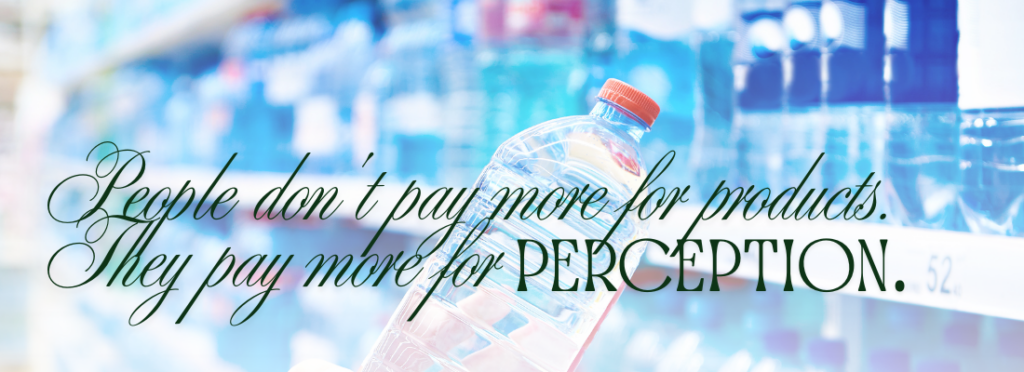
Why People Pay More for the Same Thing Wrapped in Different Packaging
The other day I found myself standing in front of a shelf at the grocery store staring at two bottles of water.
One was a perfectly ordinary bottle of water. The other was a perfectly ordinary bottle of water that apparently had graduated from a prestigious European boarding school, spent a semester abroad discovering itself, and was now packaged in a frosted bottle with a label that looked like it belonged in an art museum.
The fancy bottle cost nearly four times as much.
Now, before anyone starts writing angry emails, I understand there are differences in mineral content, sourcing, and all sorts of things that water enthusiasts will passionately explain to me. But let’s be honest for a moment. Most people weren’t buying that bottle because it was objectively four times better water.
They were buying the story.
And that simple reality is one of the most important lessons in business.
The Banana Stand Lesson
Imagine two banana stands sitting side by side.
The first has a hand-painted sign that says “Bananas – $1.”
The second has reclaimed wood shelves, Edison bulbs hanging overhead, a chalkboard sign that says “Artisanal Hand-Selected Tropical Fruit Experience,” and soft acoustic music playing in the background.
The bananas came from the same truck.
Yet one stand will charge $3 and people will happily line up to pay it.
Why?
Because human beings rarely buy products.
We buy perception.
We buy confidence.
We buy identity.
We buy stories that help us justify our decisions.
The product matters. But the way the product is presented often matters just as much.
The Niche Market Secret
One of the biggest mistakes businesses make is trying to appeal to everyone.
It sounds logical.
After all, if everyone could potentially buy your product, shouldn’t you try to attract everyone?
Not exactly.
In fact, trying to be everything to everybody usually results in becoming memorable to nobody.
Niche markets operate on a completely different principle.
They don’t try to win everyone.
They try to become the obvious choice for a specific group of people.
Consider pickup trucks.
You can buy a truck because you need to haul lumber.
Or you can buy a truck because you want everyone at the stoplight to believe you might haul lumber someday.
The manufacturers know this.
That’s why some trucks are marketed around towing capacity, while others are marketed around rugged independence, adventure, or luxury.
The same basic product.
Different packaging.
Different audience.
Different price point.
Starbucks Doesn’t Sell Coffee
At least not primarily.
If Starbucks was in the coffee business alone, they would have been defeated decades ago by convenience stores selling coffee for a fraction of the price.
Instead, Starbucks sells a feeling.
They sell consistency.
They sell an environment.
They sell a place to work, meet, relax, or pretend you’re writing the next great American novel while answering emails.
The coffee is simply the vehicle delivering the experience.
Businesses in every industry should pay attention to that.
Customers are often purchasing something larger than the actual thing being sold.
The Charter Bus Example
Our industry isn’t immune to this reality.
In fact, it might be one of the best examples.
To many first-time buyers, a bus is a bus.
It’s large.
It’s white.
It has wheels.
It gets people from Point A to Point B.
At least that’s what they think.
But experienced operators know that couldn’t be further from the truth.
Safety programs.
Driver training.
Equipment quality.
Technology.
Communication.
Reliability.
Professionalism.
These things matter enormously.
Yet customers don’t automatically know any of that.
Which means that if all we do is present a price, we reduce ourselves to a commodity.
And commodities compete on price.
The moment we stop telling our story, we force customers to compare us on numbers alone.
That is rarely a winning strategy.
The Luxury Watch Problem
I once heard someone say that luxury watches are fascinating because a $50 watch and a $50,000 watch often tell time with nearly identical accuracy.
One tells time.
The other tells a story.
One says, “It’s 2:15.”
The other says, “I’ve made it.”
People don’t always buy utility.
Sometimes they buy symbolism.
Sometimes they buy belonging.
Sometimes they buy aspiration.
Niche brands understand this better than anyone.
They aren’t selling features.
They’re selling identity.
What This Means for Your Business
The lesson isn’t that businesses should become deceptive or invent value that doesn’t exist.
Quite the opposite.
The lesson is that if you genuinely provide value, you must become better at communicating it.
Far too many companies spend years improving their product while spending almost no time explaining why those improvements matter.
Then they wonder why customers choose a competitor that appears cheaper.
The reality is that people are willing to pay more when they understand what they’re getting.
They’re willing to pay more when they trust the provider.
They’re willing to pay more when they feel understood.
And they’re willing to pay more when the experience aligns with who they are or who they want to become.
The Real Product
At the end of the day, niche markets aren’t really about products at all.
They’re about people.
They’re about understanding a specific audience so well that you can solve a problem, fulfill a desire, or create an experience that feels tailor-made for them.
When that happens, price becomes part of the conversation rather than the entire conversation.
The businesses that thrive in the future won’t necessarily be the ones with the lowest prices.
They’ll be the ones that best understand the people they serve.
Because whether it’s bottled water, coffee, pickup trucks, watches, or charter transportation, the truth remains remarkably consistent:
People rarely pay more for the thing.
They pay more for what the thing means.
And understanding that difference may be one of the most valuable lessons in business.