
User Portal 3.2 Release Notes
May 13, 2026
Your Next Software Decision Isn’t About Software
June 18, 2026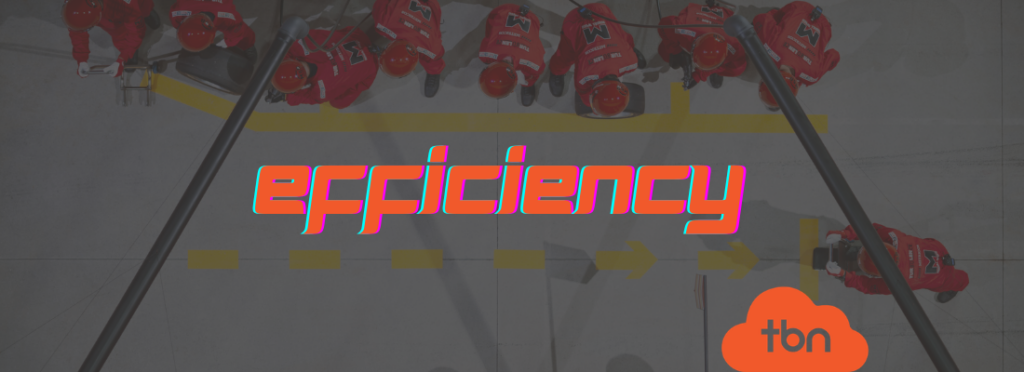
Efficiency Isn’t a Buzzword. It’s How You Fix Every Problem in Your Business.
For the last several years, “efficiency” has become one of those words that gets used so often it starts to lose meaning.
It gets tossed into sales decks, conference panels, software demos, and the occasional LinkedIn post written by someone who clearly believes every business problem can be solved with a stock photo of a person pointing at a graph.
But efficiency is not a buzzword.
At least, it shouldn’t be.
Efficiency is not about making people work harder. It is not about squeezing more blood from the same turnip, although if you have been in this industry long enough, you have probably met someone who would try.
Efficiency is about protecting the one commodity your business cannot replace.
Time.
You can buy another bus. You can hire another person. You can open a new location, build a new website, raise your rates, add new services, and replace a printer that jams every third invoice just to remind everyone who is really in charge.
But you cannot make more time.
Once it is gone, it is gone.
And that is why the lack of meaningful efficiency and automation is not just an inconvenience. It is one of the most expensive problems in your business.
The Real Cost of Inefficiency
Most operators do not wake up in the morning thinking, “Today, I would like my team to spend six hours chasing information that should have been in one place.”
And yet, that is exactly what happens in far too many businesses.
A quote needs to be updated, but the pricing logic lives in someone’s head.
A dispatcher needs to make a change, but the sales team has the latest customer note buried in an email thread.
A customer calls with a question, and suddenly three people are digging through spreadsheets like archaeologists looking for the lost city of Charteropolis.
None of this feels dramatic in the moment. It feels normal.
That is the dangerous part.
Inefficiency rarely walks into your office wearing a villain cape. It usually shows up dressed as “the way we’ve always done it.”
It is the extra phone call. The duplicate entry. The second spreadsheet. The manual reminder. The quote that took two hours longer than it should have. The follow-up that never happened because everyone thought someone else handled it.
It is death by a thousand paper cuts, except the paper is probably an Excel export named “FINAL_final_USE_THIS_ONE_v7.”
And every one of those moments costs time.
Asana’s Anatomy of Work research found that 60% of a knowledge worker’s time can be spent on “work about work” rather than skilled work itself, including hunting down documents, communicating about tasks, and managing shifting priorities. (Asana) McKinsey has also reported that up to 30% of current worked hours may potentially be replaced through automation by 2030. (McKinsey & Company)
That should get our attention.
Not because automation is coming to replace people, but because it can help return people to the work they were actually hired to do.
Efficiency Is Not About Doing Less
One of the great misunderstandings about efficiency is that it means cutting corners.
It does not.
Efficiency is not about doing less. It is about wasting less.
There is a big difference.
A NASCAR pit crew is efficient. That does not mean they are lazy. It means everyone knows what needs to happen, the process is clear, the tools are ready, and nobody is standing around wondering who misplaced the lug nuts.
That is what good operations should feel like.
Not frantic. Not chaotic. Not dependent on the one person who “just knows how we do it.”
Clear. Repeatable. Visible. Measurable.
When efficiency is done right, it creates breathing room. It gives leaders time to work on the business instead of living permanently inside the business.
And that distinction matters.
Working in the business is answering every fire drill, chasing every missing detail, approving every exception, and becoming the human glue holding together a process that should have been fixed years ago.
Working on the business is asking better questions.
Why are we quoting this way?
Why are we losing time here?
Why does dispatch not have the same information sales has?
Why are we still entering the same data in three places?
Why does this process depend on Susan being in the office, fully caffeinated, and in a good mood?
That last one may be more important than we like to admit.
Automation Gives People Their Attention Back
The goal of automation is not to remove humans from the equation.
The goal is to stop wasting human attention on work that does not require human judgment.
Your best people should not be spending their day copying information from one system to another. Your sales team should not be babysitting quotes that could have been generated faster. Your dispatchers should not be chasing trip details that should already be visible. Your leadership team should not need a detective board with yarn and pushpins to understand what happened last Tuesday.
Automation should handle the predictable so your people can focus on the meaningful.
That means sales can spend more time educating buyers, building relationships, and closing profitable work.
Dispatch can spend more time solving real operational issues instead of cleaning up avoidable confusion.
Accounting can spend more time improving cash flow instead of chasing paper trails.
Leaders can spend more time thinking strategically instead of spending their day as the company’s highest-paid search engine.
This is where efficiency becomes powerful.
It does not just save time. It redirects time.
And redirected time is where problems actually get solved.
The Front Line Feels Inefficiency First
It is easy to talk about efficiency from the leadership seat, but the people who feel inefficiency first are usually on the front lines.
They are the ones answering the customer who wants an update.
They are the ones trying to explain why a quote changed.
They are the ones managing the ripple effect when one piece of information is wrong.
They are the ones who know which processes are broken because they trip over them every single day.
If leaders want to find inefficiency, they should not start with a whiteboard in a conference room.
They should start by asking the people doing the work.
What do you enter twice?
What do customers ask that you cannot answer quickly?
Where do you loose the most time?
What task makes you think, “There has to be a better way”?
That question alone can uncover more truth than most management retreats, and it costs less than the branded notebooks.
The people closest to the work usually know where the friction is. The challenge is whether the business is willing to listen and then do something about it.
Time Saved Must Have a Job
Here is the part that often gets missed.
Saving time is not enough.
If you save ten hours a week but do not decide where that time should go, it will get swallowed by the next wave of urgent but not terribly important tasks.
Time saved needs an assignment.
Maybe it goes toward faster follow-up.
Maybe it goes toward better customer communication.
Maybe it goes toward reviewing lost quotes.
Maybe it goes toward training new team members.
Maybe it goes toward leadership finally stepping back to look at pricing, profitability, staffing, fleet utilization, or all the other things that never seem to get enough oxygen.
Efficiency without intention is just a cleaner version of chaos.
The point is not to create empty space. The point is to create useful space.
A business that saves time but does not refocus that time is like someone cleaning out the garage and then immediately filling it with more junk. It may look better for fifteen minutes, but we all know where this story ends.
The Industry Cannot Afford to Stay Manual
The motorcoach and group transportation industry has never been simple.
We deal with complex trips, changing customer expectations, driver availability, vehicle availability, school work, tours, charters, payments, cancellations, weather, traffic, and the occasional customer who believes “just a quick stop” means adding 47 minutes and a sandwich detour.
This business is complicated.
That is exactly why efficiency matters.
The more complex the business becomes, the more dangerous manual processes become. A small inefficiency in a simple business is annoying. A small inefficiency in a complex operation becomes a multiplier.
It slows quoting.
It creates confusion.
It weakens customer experience.
It burns out good people.
It hides problems until they become expensive.
Gallup’s 2026 workplace data shows global employee engagement has fallen to 20%, down from a 2022 peak of 23%. (Gallup.com) That matters because inefficient systems do not just cost time. They drain energy from the people trying to make the business work.
And in an industry already fighting for talent, attention, margin, and consistency, we cannot afford systems that make good people feel like they are pushing a bus uphill with the parking brake on.
Efficiency Is a Leadership Responsibility
Technology can help. Automation can help. Better systems can help.
But efficiency is ultimately a leadership decision.
It requires leaders to say, “We are no longer going to accept broken processes just because they are familiar.”
That can be uncomfortable.
Familiar problems have a strange way of becoming part of the furniture. Nobody likes the ugly chair in the corner, but after a while, everyone stops noticing it.
Until a customer trips over it.
The companies that will win in the next chapter of this industry are not necessarily the ones with the biggest fleets or the loudest marketing.
They will be the ones that use their time best.
They will respond faster.
They will quote smarter.
They will see problems earlier.
They will make decisions based on data instead of gut feel and guesswork.
They will use automation to take repetitive work off their teams and give meaningful work back to them.
They will understand that efficiency is not a department, a feature, or a slogan.
It is a discipline.
The Common Sense Test
At the end of the day, this really comes down to common sense.
If your team is doing the same task over and over, ask why.
If information is being entered more than once, ask why.
If customers are waiting because your team is hunting for answers, ask why.
If leaders are stuck in the weeds every day, ask why.
And then ask the most important question:
What would we do with the time if we got it back?
Because that is the real opportunity.
Efficiency is not about shaving a few minutes off a task so everyone can feel good about a dashboard.
It is about giving leaders the time to lead.
It is about giving sales teams the time to sell.
It is about giving dispatchers the clarity to dispatch.
It is about giving operators the ability to stop managing around problems and start fixing them.
The future of this industry will reward the companies that stop treating time like an unlimited resource.
It isn’t.
Time is the one thing you cannot buy more of.
So the smartest operators will stop wasting it.
#TBNDrives #TheFutureIsHere