
Why People Pay More for the Same Thing Wrapped in Different Packaging
June 23, 2026
How to Use Email to Sell Value to Your Customers
July 7, 2026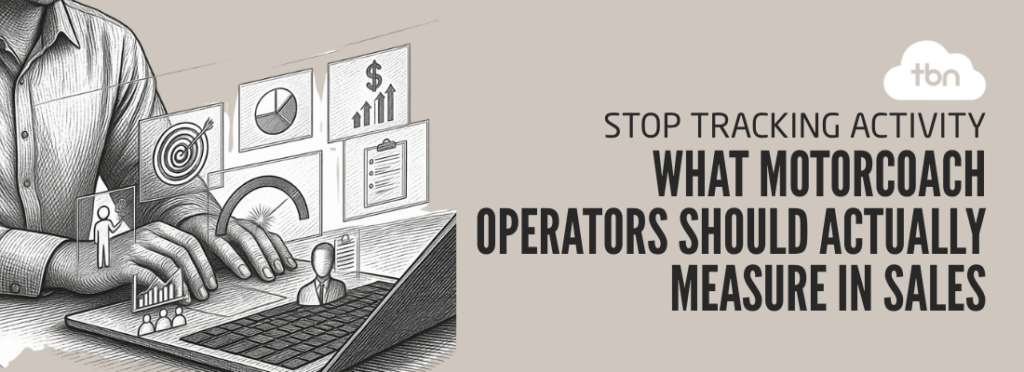
Stop Tracking Activity: What Motorcoach Operators Should Actually Measure in Sales
Counting calls and emails feels like accountability. In our industry, it usually rewards the exact behavior you’re trying to get rid of. Here’s what to measure instead — and why we built TBN to measure it.
Sooner or later, almost every operator we work with asks the same question: can we track what our salespeople are doing? Calls made, emails sent, quotes built, bookings touched.
It’s a reasonable instinct, and the goal behind it is the right one. You want to know whether your people are producing, and you want a fair way to hold them accountable when they aren’t. We take that goal seriously.
But counting activity is the wrong tool for the job. It measures the thing that’s easiest to see instead of the thing that actually matters — and in the motorcoach industry specifically, it tends to reward the very behavior you’re trying to eliminate. This is why we’ve intentionally left activity tracking out of the way TBN is designed to be used, and why it’s the centerpiece of what we’ll be teaching at the UMA Sales Summit in Nashville and at association meetings across the country.
Here’s the short version of the argument. The long version is in the resources at the bottom of this page.
Why activity tracking backfires
Activity is what people do. Outcomes are what the business gets. They are not the same thing, and the gap between them is where the trouble lives.
When you measure activity, you reward the rep who looks busiest — not the one who delivers. The person making a hundred dials a day and the person who quietly lands the biggest contract of the quarter show up very differently on an activity dashboard, and the dashboard usually flatters the wrong one. Whatever you choose to count becomes the target, and people optimize for the target. So they optimize for looking productive, because that’s what you decided to measure.
That alone is reason for caution. But in motorcoach there’s a sharper problem most operators never see coming.
In motorcoach, the activity is usually a symptom of a broken system
In most motorcoach companies, the people in “sales” aren’t salespeople in the classic sense — they’re doers. They field an inbound inquiry, chase the itinerary details, work out the equipment, build the quote by hand, and patch over whatever the system didn’t capture cleanly.
The calls and emails they generate exist because the process forced them to exist.
That changes what an activity count actually means. In a normal sales org, activity is at worst a distraction. In a motorcoach operation, the activity is frequently a signal of friction — proof that the gathering, quoting, or booking process failed and a human had to step in to rescue it. Count that activity and reward it, and you’ve just built an incentive to keep the broken parts broken, because the breakage is what generates the activity that scores well.
Consider the five-call booking
A rep logs five calls in a day on a single booking — a question about the itinerary, a change to the pickup, a follow-up on the deposit. On an activity report, that’s a productive, engaged day. Five touches. Clearly working hard.
But look at what actually happened: five calls to close one booking isn’t a good day — it’s a failure that repeated five times. The intake didn’t capture what it needed, so the customer had to be called back. Again. And again. The “activity” is the cost of a process that didn’t work the first time — and it’s a worse experience for the customer than a single clean confirmation would have been.
An activity log can’t tell the difference between a rep heroically working a hard deal and a rep thrashing because the system made them. It records both as “five calls.” So it rewards thrashing.
Activity tracking fights everything modern booking software is built to do
This is where it gets concrete. The entire direction of a platform like TBN is to take the friction out of quoting and booking — because that’s what customers overwhelmingly want today: frictionless, automated, instant. Get a number, accept it, sign it, pay it, now.
That’s not aspiration. It’s what the platform already does:
- Self-serve quote portals — customers build their own quote without a rep touching it.
- Automated email follow-ups — the system stays on the lead so a person doesn’t have to.
- Click-to-accept-and-sign contracts — the booking is confirmed and the agreement executed without a phone call.
- Click-to-pay — payment collected on the spot, no invoice to chase.
And the trajectory only accelerates. The next wave is agentic AI: tools that take a raw data source — a spreadsheet, an inbound email — and turn it into a quote or a booking with no one keying in data at all. The manual work that used to define a sales desk in this industry is being automated out of existence on purpose.
Now hold that against an activity dashboard. Every metric it counts — calls, emails, quotes built — is work the software is engineered to eliminate. Reward the activity and you’re paying bonuses for the labor your platform exists to delete. The better the system performs, the worse your people look on a dashboard that rewards motion. You’d be building a compensation plan that fights your own roadmap.
What you measure when you finally have a system
Here’s the reframe that changes everything: you count activity when you don’t yet know what drives success. You instrument everything and hunt for the correlation. That’s a legitimate phase — briefly. But the moment you’ve found what works, counting activity stops being discovery and becomes surveillance theater.
Once you know what works, you stop counting motion and measure two things, together:
- Are they working the plan? (A near-binary yes or no.)
- Did the outcome match expectation?
Read against each other, those two questions are self-correcting in a way a single activity number never can be:
| Good outcome | Bad outcome | |
|---|---|---|
| Worked the plan | The plan works — scale it. | The plan is wrong, not the person. Fix the plan. |
| Ignored the plan | Luck, or your plan is incomplete. Investigate. | Now it’s a people conversation — and you have the evidence. |
The most valuable cell is the top right: worked the plan, bad outcome. That’s the case an activity dashboard structurally cannot see, because it has no concept of “the plan.” It can only count what someone did and conclude they didn’t do enough. The two-axis model tells you something an activity count never will — that sometimes the person is fine and the system is the problem.
What to measure instead
If you’re going to stop counting activity, you need something real to count in its place. These outcome measures describe what the business actually got, and they’re hard to fake by grinding:
- New business vs. repeat / contract business. Who’s genuinely hunting new accounts versus comfortably farming the existing book. Both matter — but they’re different jobs and should be different numbers.
- Sale price vs. suggested price. Maybe the single most honest measure of a salesperson you have: are they selling value and holding the number, or buying the deal with discounts and giving away your margin?
- Customer-experience adherence — read against repeat business. Whether they delivered the experience you’ve defined as your standard. Tie it to an outcome like repeat-booking rate, not to a raw count of tasks completed — or you’ve just rebuilt activity tracking under a new name.
Surfacing the silent margin bleed
That second metric — price held against target — deserves a closer look, because most operators are bleeding margin they can’t even see.
To be clear, this is a retail conversation, not a contract one. Contract business is set, and should be. Once it’s signed, the selling is over and the job becomes delivery, not negotiation. Price flexibility lives on retail work.
And here’s the thing: that price variation already happens in your shop today — every time a rep shaves a number to land a job. But it happens quietly. Most booking software only records the price that was charged, never the price that should have been. Unless you recalculate the quote from scratch, you have no way to know a sale came in under target. The erosion never surfaces until someone does forensic accounting on your margins.
A clean incentive fixes this: give reps a discount band they can use without approval — say five percent — but every dollar of discount comes out of their bonus first. When the discount is their money, holding price stops being a rule and becomes the obvious choice. More importantly, it drags an invisible bleed into the open and turns it into a deliberate, visible business process.
The payoff: two different jobs, finally named
All of this surfaces something most operators feel but can’t articulate. There are really two jobs hiding inside the title “sales,” and they’re genuinely different work:
- The salesperson — wins new business, sells value, holds price. Generates few touches per win; a clean close looks quiet.
- The data manager — gathers, quotes, builds, keeps the system clean. Generates lots of touches by nature of the role; activity is the job, not a virtue.
The mistake isn’t having both. It’s measuring the data manager like a struggling salesperson and the salesperson like an underperforming data manager. Run an activity dashboard across both and the data manager looks like a star while your real closer looks lazy — and you’ll never understand why your best seller keeps eyeing the door.
The error isn’t having doers. It’s paying doers like sellers and measuring sellers like doers. Activity tracking is the thing that keeps the two blurred together.
The bottom line
Measure whether the system is working and whether the business is winning — not whether people look busy. Activity tracking optimizes for the job your best people should be moving away from. The model above is the one we built TBN to run, and it’s the direction we hope the industry will embrace.
Take the full thinking with you
We put the complete argument into two resources you’re welcome to download, share with your team, and bring to your next leadership conversation:
📄 The One-Page Summary — the position at a glance. The core argument, the metrics that actually matter, and the model that replaces activity tracking, on a single sheet you can hand to a leadership team. → Download the one-pager
📘 The Whole Story — the complete case. Why activity tracking backfires in motorcoach, the platform contradiction, the adherence-and-outcome model, the price-discipline mechanism, and the two-jobs framework that ties it all together. → Download the full guide
Want to talk through how this applies to your operation? Get in touch — or come find us at the UMA Sales Summit in Nashville.